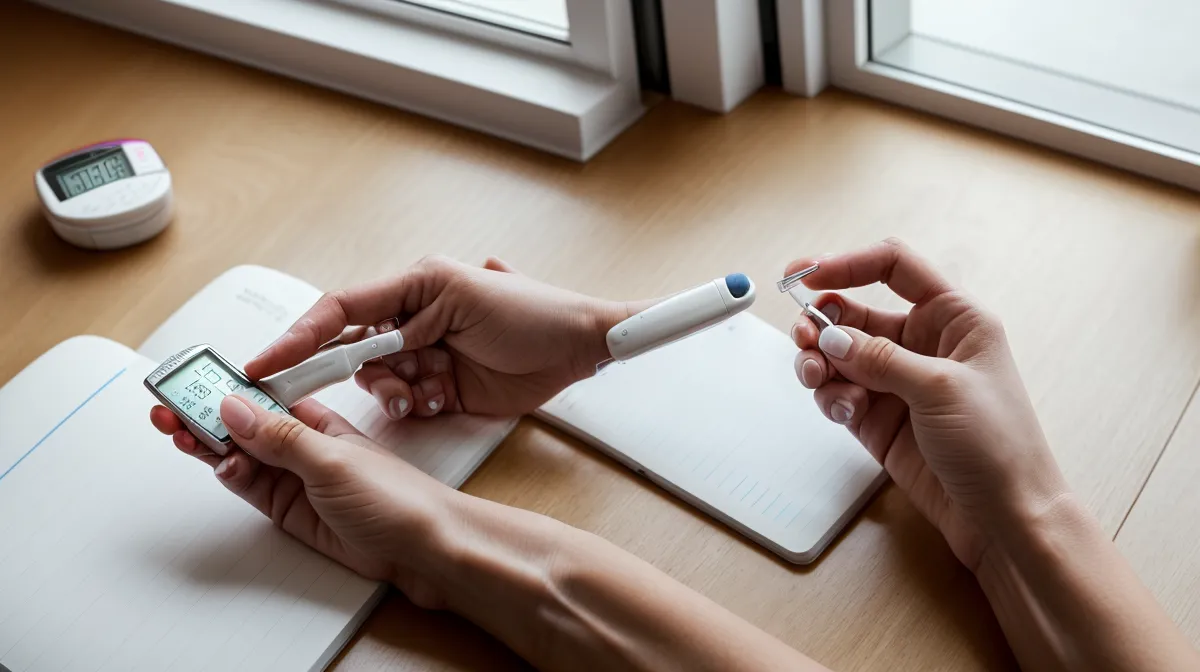
Prick, dab, count to fifteen. The number blinks up before I've even set the lancet back down, and on more days than I'd like to admit, that tiny screen decides whether my afternoon goes smoothly or falls apart by three o'clock. Blood sugar monitoring after a meal isn't the calm, once-a-day ritual I pictured when I bought my first glucometer — it turned into the sharpest, most honest feedback loop I've built into my prediabetes management, more useful than every article I read before I actually owned one.
My A1C came back in the prediabetic range during a wellness screening at work, which is its own special flavor of humiliating when you spend your days telling other people to take their health seriously. I spent the first few weeks changing nothing, convinced my usual grain bowls and sourdough habit were basically fine. They weren't. When my follow-up labs came back worse instead of better, I stopped guessing and bought a meter.
Before I ever pricked a finger, I tried the easier route — a bottle of chromium picolinate a wellness blog swore would smooth out blood sugar without changing a single meal. I took it faithfully for weeks. Nothing moved. Not my energy, not how I felt after lunch, nothing. It taught me the first real lesson of this whole mess: a pill can't tell you what's actually happening after you eat. A meter can.
Why I Even Own a Glucometer
Here's the thing about deciding to test yourself — nobody hands you a manual. I stood in the pharmacy aisle at Costco for a long time, looking at meters that all resemble tiny pagers from a decade I'd rather forget, with no idea which one actually mattered. I'm not a nurse, and none of this is medical advice; I just needed something reasonably accurate that wouldn't require a chemistry degree to operate. What I eventually figured out is that meters aren't all equally reliable, so it's worth checking that whatever you buy has a solid accuracy track record rather than grabbing the cheapest box because the packaging looks similar to the others.
Test strips are the printer ink of this whole operation — the part where the real cost sneaks up on you, one strip at a time. Early on I burned through them constantly, testing everything from a banana to a slice of pizza just to watch the invisible math play out on a little screen.
Is the Two-Hour Rule Actually Right for You?
Standard advice says test two hours after your first bite. That's the postprandial window doctors typically check, and for a while I trusted it completely. I'd test at two hours, see a tame 110 mg/dL, and mentally file the meal under "fine." Meanwhile I'd be sitting there with that heavy, foggy slump anyway, confused about why a good number didn't match how awful I felt.
A reader named Lynda Ostrowski emailed me a while back, after finding an old glycemic-index cheat sheet I'd written, asking almost the same question — why her doctor's two-hour mark never seemed to match how her body felt an hour earlier. She's disarmingly candid about her own missteps in a way that makes mine feel less lonely, and her email is part of why I started testing at other intervals instead of trusting the textbook window blindly.
So I tested at 45 minutes, 60 minutes, and 90, on top of the standard two hours. My real spike showed up much earlier than anyone had told me to expect, depending on how much fat or fiber was mixed into the meal. If you're trying to actually catch a spike instead of reading about one, timing is everything — test too late and you're only looking at the cleanup, not the event that caused it. By the time two hours rolled around, that "safe" number was just the calm after the fact, not proof the meal had been gentle on me.
My A1C is a three-month average, a blurry photo snapped from a long way off. What my meter catches after lunch is closer to video, the exact moment where something almost went sideways, the kind of detail an average that wide quietly smooths over.
Glucose Testing Tips I Wish I'd Known on Day One
Wash your hands with warm water before anything else — not just for the germs, but because the warmth gets blood moving so you're not squeezing your fingertip like it owes you money. Skip the alcohol wipe unless you're testing somewhere away from a sink; it can dry out your skin, and if it hasn't fully evaporated it can throw the reading off. Prick the side of your finger near the nail rather than the pad, since there are fewer nerve endings there, and most modern strips pull the blood up on their own the moment you touch the bead — no smearing required.
The first time, I sat at my counter for a solid ten minutes just staring at the lancing device like it might bite. When I finally pressed the button, the click was sharper than I expected, and the small bead of blood that showed up felt less dramatic than I'd built it up to be in my head. It didn't hurt the way I'd feared. It was just information.
I keep a notebook next to my Kitchen Lab notes for calculating glycemic load, food on one side, number on the other, so I can actually see the pattern instead of guessing at it after the fact.
Getting Betrayed by a Bowl of Oatmeal (and Saved by Sourdough)
The hardest morning was a bowl of steel-cut oats with a splash of almond milk, the kind of breakfast that looks like a poster for good behavior. An hour later my meter read 142, and I nearly cried over a bowl of oatmeal. How does something so boring do that much damage?
Then a slice of real, long-fermented sourdough with butter and an egg barely pushed me to 115. A supposedly safe brown rice bowl from a lunch spot sent me into the 150s. None of it matched the lists I'd been handed. Low-GI living, it turns out, isn't a fixed menu; it's specific to what your own body does with a specific plate of food, and the only way to know is to check.
Walking Off a Spike at Discovery Park
Somewhere around week eight, I started taking a loop through Discovery Park after lunch on the days I could get away, and the difference on the meter surprised me. A brisk twenty minutes among the trees there flattens my numbers more reliably than almost anything else I've tried, which is part of why I eventually wrote about how to start walking after meals to lower glucose spikes. Watching the number drop after a walk is more motivating than any lecture I ever gave at work about taking the stairs.
Around that same week, I sat through four HR meetings back to back on a Friday afternoon — the kind of day that used to send me hunting for the vending machine before the last one even started — and realized somewhere in the third meeting that I hadn't thought about food once. My desk neighbor Fatima Idrissi noticed I'd skipped the pastry tray and didn't say a word about it either way. She's never been the type to police what's on someone else's plate, which is rarer in an office than it should be.
So What Did Eight Weeks of Prediabetes Management Really Teach Me?
I still miss white bread more than I'll ever admit at a work lunch. There are days I want to throw the meter into the Sound and go back to guessing. But most days I'm grateful for it, because it turned fear into something closer to curiosity — a series of small experiments instead of a running scorecard of failure.
Along the way, I also wrote about other things I tried, including a piece on why I added GlucoBerry to my low-GI kitchen lab routine during a rough stretch with my morning numbers — a separate story from what the meter itself taught me, and not something to copy without your own doctor's input.
If there's one thing worth taking from eight weeks of finger pricks, it's this: don't trust a single number at a single timestamp to tell you the whole story. Test at 60 or 90 minutes a few times, not only at two hours, and you'll find your own personal peak instead of a stranger's average. That's the number that actually tells you something you can use tomorrow.
Some mornings the bead of blood barely shows up, and some afternoons a bowl of rice makes me want to scream. But every prick is still a choice to see what's actually happening instead of guessing. Talk to your own doctor about your targets — I'm just an HR manager with a notebook and a meter — but don't be afraid of what the data tells you. It's the only way I've found to get my numbers moving back where they belong.